
Did you know that machine learning algorithms are now capable of processing vast amounts of data to make predictions and decisions, transforming industries such as healthcare, finance, and transportation?
As a subfield of artificial intelligence, learning enables computers to improve their performance on a task without being explicitly programmed. This has led to the development of innovative applications, from recommendation systems to voice assistants and autonomous vehicles.
I will guide you through the core concepts, types, applications, and future trends of machine learning, highlighting its growing importance in today’s technological landscape.
Key Takeaways
- Understanding the basics of machine learning and its relation to artificial intelligence
- Exploring the various applications of machine learning in different industries
- Learning about the different types of machine learning algorithms and models
- Discovering the future trends and potential of machine learning
- Recognizing the importance of machine learning in today’s technological landscape
What is Machine Learning?
Machine learning is revolutionizing the way we interact with technology, but what exactly is it? As I explore this field, I’ll provide insights into its definition, core concepts, and history.
Definition and Core Concepts
Machine learning refers to the ability of machines to learn from data without being explicitly programmed. This learning enables machines to improve their performance on a task over time. At its core, machine learning involves training algorithms on data to make predictions or decisions. The field is closely related to neural networks, which are modeled after the human brain’s structure and function.
By leveraging large datasets and computational power, machine learning models can identify patterns and make accurate predictions. This capability has numerous applications across various industries, from healthcare to finance.
Brief History of Machine Learning
The term “machine learning” was coined in 1959 by Arthur Samuel, an IBM employee and pioneer in artificial intelligence. Samuel’s work on a checkers-playing program that could learn from experience marked the beginning of machine learning research. The history of machine learning is rooted in decades of human effort to study cognitive processes and develop artificial intelligence.
In 1949, Canadian psychologist Donald Hebb introduced a theoretical neural structure that influenced the development of artificial neural networks. Over the years, advancements in computing power, data availability, and algorithms have accelerated machine learning progress. Today, machine learning is a crucial aspect of many commercial applications, transforming the way businesses operate and make decisions.
How Machine Learning Differs from Traditional Programming
Machine learning enables computers to learn and improve from data, a stark contrast to traditional programming. This fundamental difference changes how we approach problem-solving in computer science.
The Traditional Programming Approach
Traditional programming involves writing explicit rules that a computer follows to perform a task. This approach relies on a programmer’s ability to anticipate and code for every possible scenario the program might encounter. It is a static method where the program’s capabilities are defined at the outset and do not change unless the code is manually updated.
Limitations of traditional programming become apparent when dealing with complex, dynamic, or uncertain environments. For instance, tasks that involve recognizing patterns in large datasets or making predictions based on historical data are challenging to accomplish with traditional programming alone.
The Machine Learning Paradigm Shift
Machine learning represents a paradigm shift by allowing computers to learn from data and improve their performance over time. Instead of being explicitly programmed for every task, a machine learning model is trained on data to identify patterns and make decisions. This approach enables systems to handle ambiguity and uncertainty more effectively than traditional programming.
As noted by pioneers in the field, “The ability to learn and adapt is a key characteristic of intelligence.” Machine learning algorithms learn to identify patterns and relationships in data without being explicitly told what to look for, making them particularly useful for tasks like image recognition, natural language processing, and predictive analytics.
The quality and quantity of data directly impact the performance of a machine learning model. The more data a model is trained on, the better it becomes at making predictions or taking actions. This data-driven nature of machine learning, coupled with its ability to improve with experience, marks a significant departure from the static nature of traditional programming.
The Relationship Between AI and Machine Learning
Artificial intelligence encompasses a broad range of disciplines, with machine learning being one of its most significant and rapidly evolving subsets. The relationship between AI and machine learning is foundational to understanding how intelligent systems are developed and applied across various industries.
Machine Learning as a Subset of AI
Machine learning is a crucial component of artificial intelligence that focuses on developing algorithms and statistical models enabling machines to perform specific tasks without explicit instructions. Instead, these systems learn from data, improving their performance over time. This learning capability is what makes machine learning a powerful tool within the broader field of artificial intelligence, allowing for applications in areas such as image and speech recognition, natural language processing, and predictive analytics.
Other AI Subfields and Their Connections
Beyond machine learning, artificial intelligence includes several other subfields that contribute to the development of intelligent systems. These include natural language processing, computer vision, robotics, and expert systems, among others. Each of these areas involves research and development aimed at creating machines that can simulate human intelligence, albeit in different ways. For instance, natural language processing enables computers to understand and generate human language, while computer vision allows them to interpret and understand visual information from the world. The integration of these subfields with machine learning is leading to the creation of more sophisticated AI systems that can tackle complex tasks.
The interconnection between these AI subfields is crucial for advancing towards more integrated and capable AI solutions. By combining machine learning with other AI disciplines, intelligence systems can be designed to not only learn from data but also to reason, understand natural language, and interact with their environment in a more human-like way.
Types of Machine Learning
Understanding the different types of machine learning is crucial for applying these techniques effectively. Machine learning algorithms are categorized based on how they learn from data and the type of data they are trained on.
Supervised Learning
Supervised learning involves training a learning model on labeled data, where the correct output is already known. The model learns to map inputs to outputs based on the labeled data. This type of learning is commonly used for classification and regression tasks.
For instance, in image classification, a supervised learning algorithm is trained on a dataset of images, each labeled with its corresponding category. The algorithm then learns to classify new, unseen images based on this training.
Unsupervised Learning
In unsupervised learning, the machine learning algorithm is trained on unlabeled data. The goal here is to identify patterns or structure within the data. Clustering and dimensionality reduction are common applications of unsupervised learning.
For example, customer segmentation in marketing is often achieved through unsupervised learning techniques, where customers are grouped based on their buying behavior and demographic characteristics.
Semi-Supervised Learning
Semi-supervised learning combines elements of both supervised and unsupervised learning. It uses a small amount of labeled data along with a larger amount of unlabeled data for training. This approach is useful when labeled data is scarce or expensive to obtain.
Reinforcement Learning
Reinforcement learning is a type of machine learning where an agent learns to make decisions by interacting with an environment. The agent receives reinforcement in the form of rewards or penalties for its actions. The goal is to learn a policy that maximizes the cumulative reward.
A notable example of reinforcement learning is the IBM Watson system that won the Jeopardy! challenge in 2011. The system used reinforcement learning to optimize its strategy for answering questions and wagering on daily doubles.
“Reinforcement learning is a powerful paradigm for training agents to make decisions in complex, uncertain environments.”
Key Machine Learning Algorithms
Machine learning algorithms have revolutionized the way we approach complex problems, offering data-driven solutions. These algorithms enable machines to learn from data, identify patterns, and make predictions or decisions.
Linear and Logistic Regression
Linear regression is a fundamental algorithm used for predicting continuous outcomes, while logistic regression is used for binary classification problems. Both are widely used in various applications, including finance and healthcare, to model the relationship between variables. Linear regression assumes a linear relationship between the independent and dependent variables, whereas logistic regression uses a logistic function to predict probabilities.
Decision Trees and Random Forests
Decision Trees are a popular algorithm used for both classification and regression tasks. They work by recursively partitioning the data into smaller subsets based on feature values. Random Forests are an ensemble learning method that combines multiple decision trees to improve the accuracy and robustness of predictions. This approach helps to reduce overfitting and improves handling of high-dimensional data.
Neural Networks
Neural Networks are a class of algorithms inspired by the structure and function of the human brain. They consist of layers of interconnected nodes or “neurons” that process inputs and produce outputs. Neural networks are particularly useful for complex tasks such as image and speech recognition, natural language processing, and more. Deep learning, a subset of neural networks, has achieved state-of-the-art results in various applications.
Clustering Algorithms
Clustering algorithms are used to group similar data points into clusters based on their characteristics. K-means clustering is a popular unsupervised algorithm that partitions data into k clusters, each represented by its centroid. Clustering is useful for identifying patterns in data, customer segmentation, image compression, and anomaly detection. As
“Clustering is a powerful technique for discovering hidden structures in data.”
, it simplifies handling extensive datasets that lack predefined labels.
Deep Learning: A Powerful Subset of Machine Learning
Deep learning has revolutionized the field of machine learning by enabling computers to learn from vast amounts of data. This subset of machine learning has gained significant attention for its ability to process complex data and improve the accuracy of various applications.
What Makes Deep Learning “Deep”
Deep learning is characterized by the use of neural networks with multiple layers. These networks are designed to mimic the human brain’s ability to learn and process information. The depth of these networks allows them to learn complex patterns and representations, making them particularly effective for tasks such as image and speech recognition.
In an artificial neural network, cells or nodes are connected, with each cell processing inputs and producing an output that is sent to other neurons. Labeled data moves through the nodes, or cells, with each cell performing a different function. This process enables deep learning models to learn and improve over time.
Types of Neural Networks
There are several types of neural networks used in deep learning, each with its own specialized applications. Convolutional Neural Networks (CNNs) are particularly effective for image processing and computer vision tasks. Their architecture is optimized for processing grid-like data such as images.
Recurrent Neural Networks (RNNs) are designed to work with sequential data and have applications in natural language processing and time series analysis. Long Short-Term Memory (LSTM) networks, a type of RNN, can learn long-term dependencies, making them useful for tasks that require understanding sequences.
Other specialized networks include Generative Adversarial Networks (GANs), which consist of two neural networks competing against each other to generate new, synthetic data that resembles the training data. This capability has numerous applications in machine learning and beyond.
The Machine Learning Process
The machine learning process is a multifaceted journey that transforms raw data into actionable insights. This process is crucial for developing effective machine learning models that can drive real-world value.
Data Collection and Preparation
Data collection and preparation are the foundational steps in the machine learning process. High-quality data is essential for training a reliable machine learning model. I gather data from various sources, ensuring it is relevant and comprehensive. The data is then cleaned and preprocessed to remove inconsistencies and handle missing values. This step is critical because the performance of the model heavily depends on the quality of the data it’s trained on.
Model Selection and Training
Once the data is prepared, the next step is to select an appropriate machine learning algorithm and train the model. The choice of algorithm depends on the problem type, such as classification or regression, and the characteristics of the data. I evaluate several algorithms and choose the one that best fits the task. The selected model is then trained on the prepared data, allowing it to learn patterns and relationships.
“The key to successful machine learning is not just the algorithm, but how well it is trained on the data.”
Evaluation and Deployment
After training, the machine learning model is evaluated using a separate set of data to assess its performance and accuracy. Metrics such as accuracy, precision, recall, and F1-score are used for classification problems, while RMSE and MAE are used for regression tasks. Techniques like cross-validation help ensure that the model generalizes well to new data. Once the model is deemed satisfactory, it is deployed into a production system where it can generate real-world value. Continuous evaluation and retraining are crucial to maintain the model’s performance over time as data distributions change.
Real-World Applications of Machine Learning
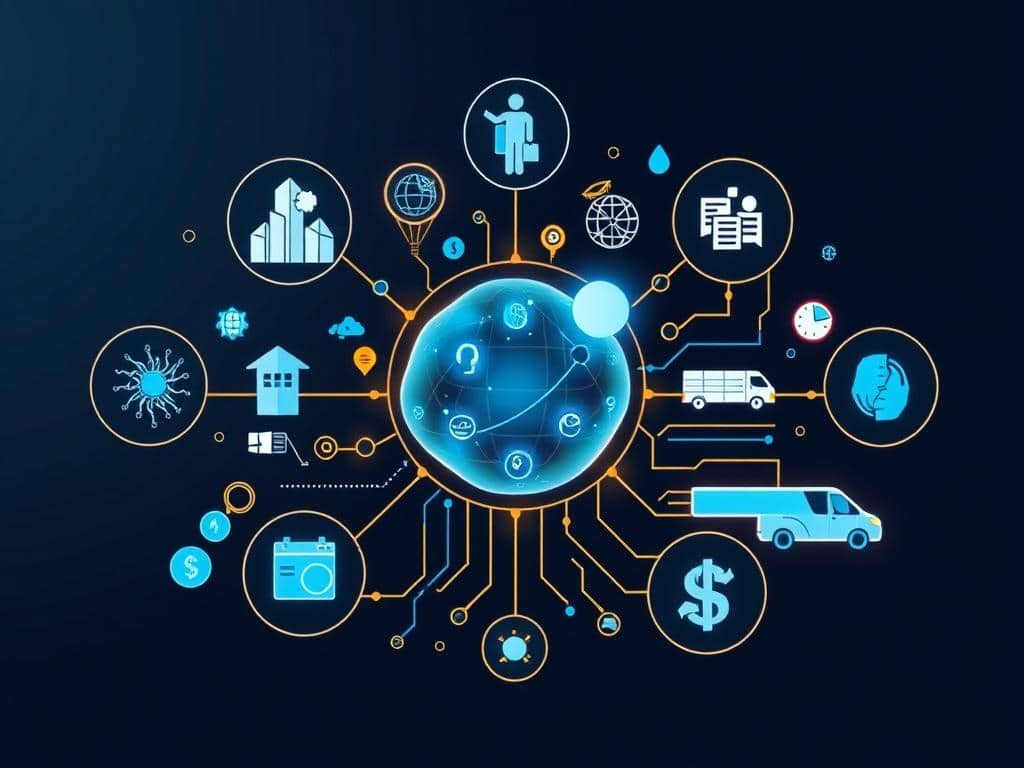
The applications of machine learning are vast and varied, impacting sectors from healthcare to transportation. Machine learning technology is being increasingly adopted across different industries to improve efficiency, decision-making, and customer experiences.
Healthcare and Medical Diagnostics
In healthcare, machine learning is revolutionizing medical diagnostics by analyzing complex medical data to predict patient outcomes and identify potential diseases earlier. For instance, machine learning algorithms can analyze medical images to detect abnormalities, such as tumors, more accurately and quickly than human clinicians.
Financial Services and Fraud Detection
Machine learning is also being extensively used in financial services for fraud detection. By analyzing transaction patterns and identifying anomalies, machine learning systems can help prevent fraudulent activities, reducing financial losses for institutions and protecting customer accounts.
The use of machine learning in financial services enhances security and improves the efficiency of financial transactions.
Retail and Recommendation Systems
In retail, machine learning powers recommendation systems that suggest products to customers based on their browsing and purchasing history. This personalized approach enhances customer experience and increases sales for retailers.
By analyzing customer data, machine learning algorithms can predict preferences and tailor marketing efforts accordingly.
Transportation and Autonomous Vehicles
Much of the technology behind self-driving cars is based on machine learning, deep learning in particular. Machine learning algorithms enable autonomous vehicles to perceive their environment, make decisions, and navigate safely.
Applications of machine learning in transportation also include route optimization, predictive maintenance, and traffic management, improving the efficiency and safety of transportation systems.
Natural Language Processing and Machine Learning

The integration of natural language processing (NLP) with machine learning has revolutionized the way machines understand human language. NLP enables familiar technology like chatbots and digital assistants such as Siri or Alexa to comprehend and respond to voice commands.
How Machines Understand Human Language
Machine understanding of human language is facilitated through speech recognition, also known as automatic speech recognition (ASR). This capability uses NLP to translate human speech into a written format, enhancing accessibility and user experience in mobile devices.
By leveraging machine learning algorithms, NLP systems can learn from large datasets, improving their accuracy over time. This learning process is crucial for developing sophisticated language models.
NLP Applications in Daily Life
NLP applications are ubiquitous in daily life, often operating behind the scenes. Virtual assistants like Siri, Alexa, and Google Assistant utilize NLP to understand and respond to voice commands, making them indispensable tools.
Other significant applications include machine translation services like Google Translate, which convert text between languages with increasing accuracy. Additionally, chatbots and conversational agents use NLP to provide customer service, answer questions, and assist with tasks.
Furthermore, NLP powers content recommendation systems that suggest articles, videos, and products based on user preferences. It also enables text analysis applications like sentiment analysis, helping companies understand customer opinions from reviews and social media.
As machine learning continues to evolve, we can expect NLP applications to become even more sophisticated, enhancing their ability to understand and generate human-like language. This synergy between NLP and machine learning is poised to drive significant advancements in technology and data analysis.
Computer Vision and Image Recognition

The integration of machine learning into computer vision has revolutionized the way machines interpret visual data. This synergy has enabled significant advancements in image recognition, allowing machines to be trained to perform complex tasks with high precision.
Teaching Machines to “See”
Teaching machines to “see” involves training them to analyze and understand visual data from images. This is achieved through machine learning algorithms that can learn from large datasets, improving their accuracy over time. The process includes data collection, where images are gathered and labeled, followed by the application of learning algorithms to enable the machine to recognize patterns.
The ability of machines to “see” has numerous applications, including facial recognition, medical image analysis, and quality control in manufacturing. By leveraging machine learning, these systems can be trained to detect subtle differences and anomalies, enhancing their utility across various industries.
Image Recognition Applications
Image recognition has diverse applications across multiple sectors. In healthcare, it is used for medical image analysis to diagnose diseases from X-rays and MRIs. In retail, visual search enables customers to find products by uploading images. Industrial applications include quality control and defect detection in manufacturing processes. Furthermore, applications in security and surveillance, such as facial recognition for authentication and security, have become increasingly prevalent.
Emerging applications of image recognition include augmented reality, content moderation, and satellite imagery analysis for environmental monitoring. These applications demonstrate the vast potential of image recognition technology powered by machine learning, transforming various aspects of our lives and industries.
Machine Learning Tools and Frameworks

The world of machine learning is filled with a variety of tools and frameworks, each with its strengths and weaknesses. Selecting a platform can be a challenging process, as the wrong system can drive up costs or limit the use of other valuable tools or technologies.
Popular Libraries and Platforms
Several popular libraries and platforms are widely used in the industry. TensorFlow, PyTorch, and Scikit-learn are some of the most popular machine learning frameworks. These frameworks provide a wide range of tools and libraries for building and deploying machine learning models.
TensorFlow is an open-source framework developed by Google, widely used for large-scale machine learning deployments. PyTorch is another popular framework known for its ease of use and flexibility. Scikit-learn is a widely used library for learning and modeling data.
Choosing the Right Tools for Your Project
When choosing tools for your project, several factors need to be considered. The type of problem you’re trying to solve, the expertise of your team, the deployment environment, and performance requirements are all crucial. It’s also essential to consider the tradeoffs between different frameworks in terms of ease of use, flexibility, performance, and community support.
For production deployment, scalability, integration capabilities, and maintenance requirements should be evaluated. You should also consider whether to use cloud-based machine learning services or develop custom solutions. By understanding your project needs and constraints, you can make an informed decision and choose the most suitable tools and technologies.
Challenges and Limitations of Machine Learning
Despite its potential, machine learning faces several limitations that need to be addressed. As machine learning continues to evolve and become increasingly integral to various industries, understanding these challenges is crucial for its effective application.
Data Quality and Quantity Issues
One of the primary challenges in machine learning is the quality and quantity of data. Machine learning models require large amounts of high-quality data to learn and make accurate predictions. However, obtaining such data can be difficult due to issues like noise, missing values, and bias.
Bias and Fairness Concerns
Machine learning models can perpetuate and even amplify existing biases if they are trained on biased data. This can lead to unfair outcomes and discrimination in areas like hiring, lending, and law enforcement. Ensuring fairness and mitigating bias in machine learning systems is a significant challenge.
Explainability and Transparency
Another area of concern is explainability, or the ability to understand what the machine learning models are doing and how they make decisions. As noted by experts, understanding why a model does what it does is a difficult question, and it’s essential to treat models as transparent systems rather than “black boxes.” Techniques like interpretable models, post-hoc explanation methods, and visualization tools can help improve understanding and transparency.
In high-stakes domains like healthcare, finance, and criminal justice, the need for transparency and understanding of machine learning systems is particularly critical. Emerging regulations also require algorithmic transparency and the right to explanation for automated decisions, further emphasizing the importance of addressing these challenges.
Ethical Considerations in Machine Learning
The growing presence of machine learning in our daily lives raises important questions about the ethical considerations surrounding its development and deployment. As machine learning systems become more pervasive, the need to address these ethical concerns becomes increasingly urgent.
Privacy and Data Protection
One of the critical ethical considerations in machine learning is data privacy and protection. Machine learning models require vast amounts of data to learn and make accurate decisions. However, this reliance on data raises concerns about how data is collected, stored, and used. Ensuring that data is handled responsibly is crucial to maintaining user trust and complying with data protection regulations.
I will explore the complex questions of who is responsible when machine learning systems cause harm or make problematic decisions. This involves discussing the “responsibility gap” that emerges when autonomous systems make decisions without clear human accountability.
Accountability and Responsibility
Assigning responsibility among various stakeholders, including developers, deployers, users, and the systems themselves, is a significant challenge. Establishing governance frameworks and ethical guidelines for machine learning development and deployment is essential. Emerging approaches to algorithmic accountability, such as impact assessments, auditing, and certification standards, can help mitigate these issues.
To build responsible AI practices, organizations can foster diverse teams, implement ethical review processes, and engage in ongoing monitoring. By doing so, they can ensure that their machine learning systems are developed and used responsibly, minimizing harm and promoting beneficial outcomes.
Getting Started with Machine Learning

Embarking on a machine learning journey requires a comprehensive understanding of its core concepts and applications. To get started, it’s essential to understand the basics of machine learning and its significance in today’s technological landscape.
Essential Skills and Knowledge
To succeed in machine learning, one needs to acquire specific skills and knowledge. This includes a strong foundation in mathematics, particularly in linear algebra, calculus, and probability. Programming skills, especially in Python, are also crucial. Familiarity with data structures, algorithms, and software development methodologies is beneficial. Understanding the principles of data preprocessing, feature engineering, and model evaluation is vital for building effective machine learning models.
Moreover, knowledge of machine learning frameworks and libraries such as TensorFlow, PyTorch, or scikit-learn can significantly accelerate the learning process. Staying updated with the latest research and advancements in the field is also important, as machine learning is a rapidly evolving discipline.
Learning Resources and Pathways
Several online courses and platforms offer structured machine learning education. Coursera, edX, and Udacity provide a range of courses from beginner to advanced levels. For those seeking free resources, Stanford’s CS229, fast.ai, and MIT OpenCourseWare are excellent choices. Textbooks like “Pattern Recognition and Machine Learning” by Christopher Bishop and blogs such as Towards Data Science are valuable learning resources.
YouTube channels dedicated to machine learning, such as those by Andrew Ng and Siraj Raval, offer insightful explanations and tutorials. For practical experience, participating in Kaggle competitions and working on personal projects can help solidify theoretical knowledge. The key to successful learning is a combination of theoretical understanding and hands-on practice.
The Future of Machine Learning
With the rapid evolution of machine learning, it’s essential to examine the potential impact on our future. As machine learning continues to advance, we can expect significant transformations in various sectors.
Emerging Trends and Technologies
The field of machine learning is witnessing the emergence of new trends and technologies that are likely to shape its future. Advances in deep learning and reinforcement learning are enabling machines to perform complex tasks with greater accuracy. Additionally, the integration of machine learning with other technologies like the Internet of Things (IoT) and blockchain is expected to unlock new possibilities.
As noted by experts, “The future of machine learning is closely tied to its ability to adapt to new data and environments.”
“Machine learning will continue to be a key driver of technological innovation, transforming industries and revolutionizing the way we live and work.”

Potential Impact on Society and Work
The potential impact of machine learning on society and work is multifaceted. While there are concerns about job displacement, it’s also likely to create new job opportunities in fields related to AI and machine learning. As Andrew Ng once said, “AI is the new electricity. Just as electricity transformed numerous industries, AI will do the same.”
To mitigate the negative effects and maximize the benefits, it’s crucial to implement proactive policies and education. This includes upskilling the workforce and ensuring that the benefits of machine learning are widely distributed. By doing so, we can harness the power of machine learning to drive positive change and create a better future for all.
Conclusion
Our exploration of machine learning has revealed a complex and fascinating field that is transforming industries and reshaping our future. Throughout this guide, we’ve covered the core concepts, types, and applications of machine learning, highlighting its potential to revolutionize numerous aspects of our lives.
The ability of machine learning algorithms to learn from data and improve over time is driving innovation in various sectors, from healthcare to finance. As we continue to use and develop this technology, it’s crucial to address the challenges associated with it, such as bias and fairness concerns.
In business and beyond, machine learning is not just a tool; it’s a paradigm shift. I encourage you to continue learning about this rapidly evolving field, as it will undoubtedly shape our collective future.