
Did you know that intelligence is being revolutionized by machines that can process vast amounts of data to make informed decisions? The field of computer science focused on creating systems that can perform tasks typically requiring human intelligence is known as Artificial Intelligence.
I will introduce you to the concept of Artificial Intelligence and its comprehensive overview, highlighting its significance in modern society and its growing impact across various industries.
Key Takeaways
- Understanding the basics of Artificial Intelligence and its applications.
- Exploring how machine learning enables intelligence in systems.
- The role of data and information in Artificial Intelligence.
- The impact of Artificial Intelligence on various industries.
- The significance of research and development in Artificial Intelligence.
What Is Artificial Intelligence?
At its core, artificial intelligence is about creating systems that can reason, learn, and act like humans, a notion that has fascinated scientists and researchers for decades. As a field of science, AI is concerned with building computers and machines that can perform tasks that typically require human intelligence. This involves a range of advanced functions, including the ability to see, understand and translate spoken and written language, analyze data, and make recommendations.
Definition and Core Concepts
Artificial intelligence can be defined as the capability of computational systems to perform tasks typically associated with human intelligence, including learning, reasoning, problem-solving, and decision-making. The core concepts that underpin AI include the difference between AI as a field of research and AI as a set of technologies. Understanding these concepts is crucial to grasping how AI works and its potential applications.
AI involves creating machines that can perceive their environment and take actions to maximize their chances of achieving specific goals. This is achieved through complex algorithms and data processing, enabling computers to learn from data and improve their performance over time.
Brief History of AI Development
The development of artificial intelligence as a field of research began to take shape in the mid-20th century. The term “Artificial Intelligence” was formally coined in 1956 at the Dartmouth Conference, marking the beginning of AI as an academic discipline. Since then, AI has evolved through several stages, from its conceptual beginnings to the development of the first AI programs and expert systems.
Key historical moments in AI research have shaped our current understanding of artificial intelligence and its capabilities. These milestones include the development of machine learning algorithms and the emergence of deep learning techniques, which have significantly advanced the field.
The Evolution of Artificial Intelligence
The journey of artificial intelligence from theoretical concepts to practical applications is a fascinating story. As we explore this evolution, we see how intelligence has been a driving force behind many technological advancements.
Key Milestones in AI History
The development of artificial intelligence has been marked by several significant milestones. In 1950, Alan Turing published “Computing Machinery and Intelligence,” introducing the “Turing Test.” This was followed by John McCarthy coining the term “artificial intelligence” at the first AI conference in 1956. Other notable events include Frank Rosenblatt building the Mark1 Perceptron in 1967 and the widespread use of neural networks with backpropagation in 1980. These advancements highlight the rapid development of AI systems over time.
From Early Concepts to Modern Applications
Early AI research focused on symbolic approaches and rule-based systems, but over time, the field shifted toward machine learning and more complex computer algorithms. Despite facing periods of optimism followed by “AI winters,” the field continued to advance. Modern AI applications, powered by advancements in technology and the availability of vast amounts of data, have led to significant breakthroughs in areas such as natural language processing and computer vision. Today, AI machines are capable of performing tasks that were previously thought to be the exclusive domain of humans, marking a significant milestone in the evolution of intelligence.
How AI Works: The Technical Foundation
Understanding the technical foundation of artificial intelligence is crucial for grasping its capabilities and limitations. At its core, AI relies on complex processes to analyze data and make informed decisions.
The core principle of intelligence in AI systems revolves around data. AI learns and improves through exposure to vast amounts of data, identifying patterns and relationships that humans may miss. This learning process is fundamental to AI’s ability to enhance its performance over time.
Data Processing and Pattern Recognition
AI systems collect, analyze, and interpret large volumes of data to identify patterns and make predictions. This is achieved through various processing techniques that transform raw data into meaningful information. As noted by experts, “The ability to process and analyze data is what enables AI systems to learn and improve.” The quality of the data directly impacts the AI’s ability to recognize patterns accurately.
Effective data processing is crucial for AI’s pattern recognition capabilities. By analyzing vast datasets, AI can identify complex patterns that may elude human observers. This capability is foundational to many AI applications, from image recognition to predictive analytics.
Algorithms and Decision-Making Processes
The role of algorithms in AI systems is to guide the analysis and decision-making processes. These algorithms are sets of rules or instructions that enable AI to interpret data and make informed decisions. The sophistication of these algorithms directly influences the AI’s ability to solve complex problems.
“Algorithms are the backbone of AI, enabling it to transform data into actionable insights.”
The interplay between data quality, algorithm sophistication, and overall AI performance is intricate. High-quality data and advanced algorithms are essential for AI systems to make accurate decisions and drive meaningful outcomes.
Types of Artificial Intelligence
As we explore the vast landscape of artificial intelligence, it’s essential to understand the different types that are shaping our technological future. Artificial intelligence is not a single entity, but rather a collection of different types that are being researched and implemented.
Narrow AI vs. General AI
Narrow AI, also known as weak AI, is designed to perform specific tasks. It is trained on large datasets and can excel in tasks such as image recognition, language translation, and playing chess. On the other hand, general AI, also known as strong AI, is a theoretical concept that refers to a machine that can perform any intellectual task that a human can. General AI would have the ability to reason, learn, and apply knowledge across different domains, much like human intelligence.
The key difference between narrow AI and general AI is the scope of their capabilities. While narrow AI is limited to a specific domain, general AI would be able to generalize across multiple domains. Currently, narrow AI is the dominant form of AI, and it has many practical applications in areas such as healthcare, finance, and transportation.
Reactive Machines and Limited Memory AI
Reactive machines are a type of AI that can only react to stimuli based on preprogrammed rules. They do not have the ability to learn or remember past experiences. An example of a reactive machine is IBM’s Deep Blue chess computer, which can play chess at a grandmaster level but cannot learn or improve over time.
Limited memory AI, on the other hand, can learn from past experiences and improve over time. This type of AI is used in many modern applications, such as self-driving cars, speech recognition systems, and personalized recommendation systems. Limited memory AI is a significant improvement over reactive machines, as it can adapt to new situations and improve its performance over time.
Theory of Mind and Self-Aware AI
Theory of mind AI refers to a hypothetical AI system that can understand and interpret the mental states of humans, such as beliefs, desires, and intentions. This type of AI would be able to understand the context and nuances of human behavior, enabling it to make more informed decisions. However, theory of mind AI is still a topic of research and has not yet been implemented in practice.
Self-aware AI is another theoretical concept that refers to a machine that is aware of its own existence and has a sense of self. This type of AI would be able to understand its own strengths and weaknesses, as well as its own emotions and motivations. While self-aware AI is still a topic of debate among researchers, it remains a fascinating area of exploration in the field of artificial intelligence.
Machine Learning: The Engine of AI
Machine learning serves as the backbone of contemporary AI, facilitating the development of intelligent systems that can adapt and learn. By leveraging various algorithms and models, machine learning enables computers to improve their performance on specific tasks with experience.
Supervised Learning
Supervised learning is a type of machine learning where algorithms are trained on labeled data to make predictions or classifications. This training process involves mapping specific inputs to outputs based on the provided labels. For instance, in image recognition tasks, supervised learning can be used to identify objects in images by learning from a dataset where each image is labeled with the object it contains.
Unsupervised Learning
In contrast, unsupervised learning involves learning patterns from unlabeled data without knowing the end result ahead of time. This approach is useful for discovering hidden structures or groupings within the data. Clustering and dimensionality reduction are common applications of unsupervised learning, where the goal is to identify meaningful representations of the data without prior knowledge of the expected outcomes.
Reinforcement Learning
Reinforcement learning is a “learn by doing” approach where an “agent” learns through trial and error by interacting with its environment and receiving positive or negative feedback. This type of learning is crucial for developing AI agents that can make decisions in complex, dynamic environments. Through reinforcement learning, agents can learn optimal behaviors or policies that maximize their rewards over time.
In conclusion, machine learning is a fundamental component of artificial intelligence, driving advancements in various fields through its ability to enable systems to learn and adapt. By understanding the different types of machine learning, including supervised, unsupervised, and reinforcement learning, we can better appreciate the potential of AI to transform industries and improve our daily lives.
Deep Learning and Neural Networks
Neural networks, the backbone of deep learning, are designed to mimic the human brain’s ability to learn and adapt. By using multiple layers of artificial neurons, these networks can process complex patterns in data, enabling machines to make accurate predictions and decisions.

Mimicking the Human Brain
The structure of neural networks is inspired by the human brain’s neural connections. Each layer in the network processes and transforms data through multiple stages, allowing the network to learn and represent complex information. This hierarchical representation is key to the success of deep learning models.
By stacking multiple layers, deep neural networks can automatically extract features from raw data, eliminating the need for manual feature engineering.
Types of Neural Networks
There are several types of neural networks, each with unique architectures and applications. Feedforward neural networks are the simplest type, where information flows only in one direction. Recurrent neural networks (RNN) and Long Short-Term Memory (LSTM) networks are designed for sequential data, such as time series or natural language processing tasks.
Convolutional neural networks (CNN) are particularly effective for image and video processing, while Generative Adversarial Networks (GAN) have shown remarkable capabilities in generating realistic synthetic data.
Training Deep Learning Models
The training process for deep learning models involves optimizing the network’s weights and biases to minimize the error between predicted and actual outputs. This is achieved through backpropagation and gradient descent algorithms, which adjust the network’s parameters to improve its performance on the task at hand.
Effective training requires large amounts of data and computational resources, but the result is a highly accurate model capable of making precise predictions and decisions.
Natural Language Processing

NLP is a crucial aspect of AI that deals with the interaction between computers and humans in natural language. It allows programs to read, write, and communicate in human languages such as English, enabling applications like speech recognition, speech synthesis, and machine translation.
How Computers Understand Human Language
The process of understanding human language involves several technical approaches. Computers use techniques like tokenization, parsing, and semantic analysis to process text and speech. Modern NLP systems utilize word embeddings and transformer architectures to capture the meaning and context of language, thereby improving language understanding.
These advancements have enabled machines to interpret human language more accurately, facilitating applications such as virtual assistants and sentiment analysis.
Applications of NLP in Modern Technology
NLP has numerous real-world applications in modern technology. It is used in virtual assistants like Siri and Alexa, machine translation services like Google Translate, and sentiment analysis tools used by businesses to understand customer feedback. Additionally, NLP is employed in text summarization and question answering systems, making it a versatile technology.
Recent advances in NLP have led to the development of systems like GPT, which can generate coherent text and engage in human-like conversations, further expanding the possibilities of natural language processing.
Computer Vision and Perception
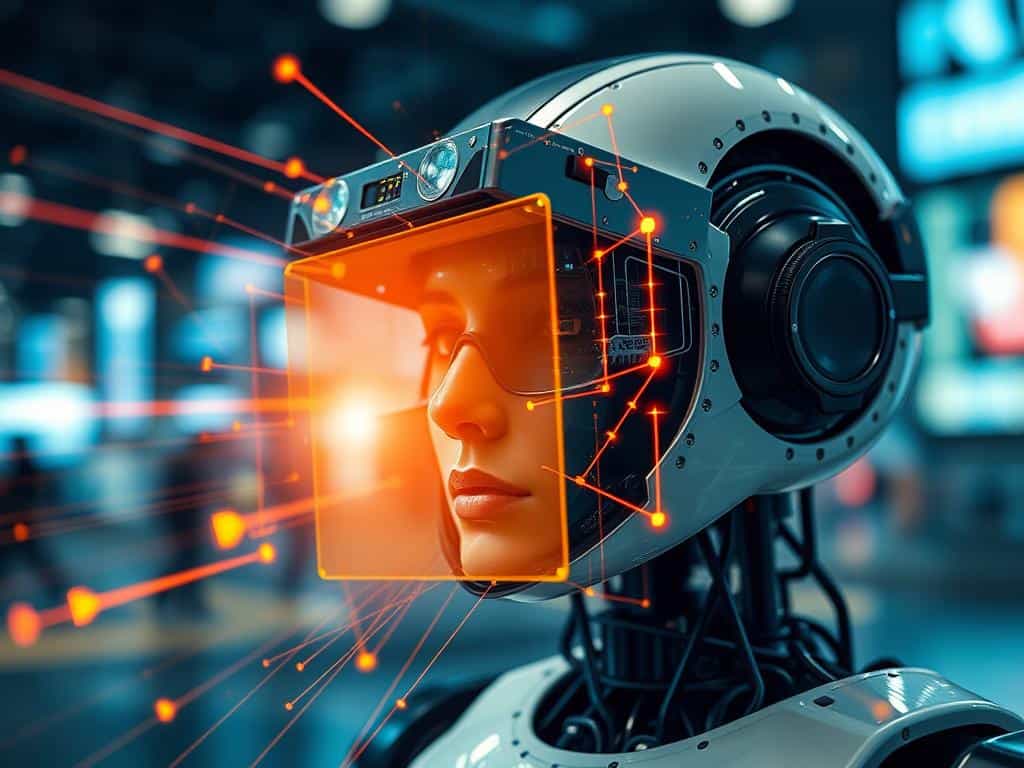
Computer vision, a crucial aspect of artificial intelligence, enables machines to interpret and understand visual data from the world. This technology has seen significant advancements, transforming how machines interact with their environment.
Image Recognition and Processing
Image recognition is a key application of computer vision, where machines are trained to identify and classify visual inputs. This is achieved through complex algorithms that process image data, extracting features and detecting objects within scenes.
The process involves several stages, including data collection, feature extraction, and object detection. Convolutional neural networks have been instrumental in revolutionizing this field by automatically learning patterns in visual data.
Real-World Applications of Computer Vision
Computer vision has numerous real-world applications, including autonomous vehicles, medical imaging, surveillance, and augmented reality. These applications rely on the ability of computer vision systems to accurately analyze visual input and make informed decisions.
In computer vision, the integration with other AI technologies enhances perception capabilities, enabling more sophisticated applications. For instance, in autonomous vehicles, computer vision is used alongside sensor data to navigate safely.
As computer vision continues to evolve, we can expect to see even more innovative applications across various industries, further enhancing the capabilities of machines to understand and interact with their environment.
Generative AI: Creating Original Content
Generative AI represents a groundbreaking advancement in artificial intelligence, enabling the creation of original content. This technology has far-reaching implications across various industries, from media and entertainment to marketing and design.

How Generative Models Work
Generative models are a class of deep learning algorithms that can produce complex, original content, such as long-form text, high-quality images, realistic video, or audio, in response to a user’s prompt. These models achieve this by encoding a simplified representation of their data, then drawing from that representation to create new work that’s similar yet distinct from the original data.
The process involves training these models on vast amounts of data, allowing them to learn patterns and generate new content based on those patterns.
Text, Image, and Video Generation
Generative AI tools like GPT, DALL-E, and Midjourney have revolutionized content generation across industries. These deep learning networks can produce a wide range of content, from coherent text and realistic images to sophisticated video and audio files.
The applications are vast, ranging from automated content creation in media to generating synthetic data for training other AI models. As these technologies continue to evolve, we can expect to see even more innovative uses of generative AI in the future.
AI in Business and Industry
AI’s impact on business is multifaceted, enhancing processes, customer service, and decision-making. As companies across various industries adopt AI technologies, they are experiencing significant improvements in operational efficiency and customer engagement.
Automation and Process Optimization
AI enables automation and process optimization, reducing costs and improving efficiency in manufacturing, logistics, and administrative functions. For instance, AI can help automate aspects of cybersecurity by continuously monitoring network traffic, thereby enhancing the security of systems. Additionally, machine learning models can analyze data from sensors to forecast when maintenance will be required, predicting equipment failures before they occur.
This proactive approach to maintenance not only reduces downtime but also extends the lifespan of equipment, contributing to overall cost savings. By leveraging AI for process optimization, businesses can streamline their operations, making them more agile and responsive to changing market conditions.
Customer Service and Personalization
AI enhances customer service through the use of chatbots, virtual assistants, and personalization engines that deliver tailored experiences. Companies can implement AI-powered chatbots to handle customer inquiries, providing 24/7 support and improving customer satisfaction. Moreover, AI-driven personalization engines can analyze customer data to offer relevant products or services, enhancing the overall customer experience.
By adopting these AI-powered tools, businesses can not only improve customer service but also gain valuable insights into customer behavior and preferences, enabling more targeted marketing strategies.
Decision Support and Predictive Analytics
AI plays a crucial role in decision support and predictive analytics, helping businesses forecast trends, identify opportunities, and mitigate risks. By analyzing vast amounts of data, AI systems can provide actionable insights that inform strategic decision-making. Furthermore, predictive analytics can help businesses anticipate changes in market conditions, allowing them to adjust their strategies accordingly.
The integration of AI in business systems for decision support and predictive analytics is becoming increasingly important as companies seek to stay competitive in a rapidly evolving market landscape.
AI in Everyday Life
Our daily routines are increasingly being influenced by artificial intelligence, often in ways we don’t even notice. From simplifying tasks to enhancing our entertainment experiences, AI is subtly transforming how we interact with our environment.
Virtual Assistants and Smart Homes
Virtual assistants like Siri, Alexa, and Google Assistant have revolutionized the way we manage our homes and daily tasks. These AI-powered assistants can understand and respond to our requests, control smart home devices, and even help us with daily routines. With the integration of AI in smart home systems, our living spaces are becoming more automated and efficient, making it easier to use technology to our advantage.
AI in Entertainment and Social Media
AI is also significantly impacting the way we consume entertainment and interact on social media. Recommendation systems used by platforms like YouTube, Amazon, and Netflix rely on AI to personalize our content feeds, suggesting new music, movies, and products based on our preferences. Furthermore, AI-driven applications are enhancing our social media experiences by suggesting connections and content that align with our interests. As AI continues to evolve, its use in entertainment and social media is likely to become even more sophisticated, further enriching our everyday experiences with artificial intelligence.
The influence of AI extends beyond entertainment, as it is increasingly embedded in various aspects of our lives, from smartphone technology to household appliances, subtly transforming how we interact with our environment and simplifying our daily tasks.
Benefits and Advantages of AI
Artificial Intelligence (AI) is transforming the way we live and work, bringing numerous benefits and advantages to various aspects of our lives. The intelligence provided by AI systems is revolutionizing industries and enhancing overall performance.
Efficiency and Productivity Improvements
AI drives efficiency and productivity improvements by automating repetitive tasks, processing information faster than humans, and operating continuously without breaks. This results in significant time savings and reduced operational costs. With AI, organizations can achieve more accurate and faster decision-making, leading to improved overall performance.
Innovation and Problem-Solving Capabilities
AI’s ability to analyze vast datasets and identify patterns that humans might miss enables significant innovation and problem-solving capabilities. By leveraging artificial intelligence, businesses can free human workers to focus on creative tasks and suggest novel solutions to complex problems, thereby enhancing overall performance and driving progress.
The integration of AI into various industries is expected to continue to yield substantial benefits, making it an indispensable tool for modern businesses and organizations.
Challenges and Limitations of AI
The development and deployment of AI systems are not without their challenges, including technical, security, and data-related issues. As AI continues to integrate into various aspects of our lives, understanding these limitations is crucial.
Technical Challenges
One of the significant technical challenges in AI development is creating systems that can generalize beyond their training data or adapt to novel situations. This requires advancements in areas like machine learning and deep learning.
Moreover, ensuring that AI systems are robust against adversarial attacks and can maintain their performance over time is a complex task. It involves ongoing research and development to stay ahead of potential vulnerabilities.
Data Privacy and Security Concerns
AI systems rely heavily on data, which can be vulnerable to data poisoning, tampering, bias, or cyberattacks leading to data breaches. Ensuring the security of AI models and the data they process is paramount.
Threat actors can target AI models for theft, reverse engineering, or unauthorized manipulation, highlighting the need for robust security measures to protect these systems.
Computational Requirements
Training large AI models requires substantial computational resources, which can have a significant environmental impact. The energy consumption associated with training and maintaining these models is a growing concern.
Efforts to develop more efficient algorithms and hardware are underway to mitigate this issue, making AI more sustainable in the long term.
In conclusion, while AI has the potential to revolutionize numerous sectors, it is crucial to address the challenges and limitations associated with its development and deployment. By understanding and mitigating these issues, we can ensure that AI is used effectively and responsibly.
Ethical Considerations in AI
As we explore the vast landscape of artificial intelligence, we must consider the ethical implications that come with its development and deployment. AI ethics is a multidisciplinary field that studies how to optimize AI’s beneficial impact while reducing risks and adverse outcomes.
Common values associated with AI ethics include explainability and interpretability, fairness and inclusion, robustness and security, accountability and transparency, and privacy and compliance. If organizations don’t prioritize safety and ethics when developing and deploying AI systems, they risk committing privacy violations and producing biased outcomes.
Bias and Fairness Issues
One of the critical ethical considerations is addressing bias and fairness issues in AI systems. Biases in training data can lead to discriminatory outcomes that affect marginalized groups. For instance, if an AI system is trained predominantly on data from one demographic, it may not perform well or be fair when applied to others.
To mitigate this, it’s essential to ensure that training data is diverse and representative. Moreover, ongoing monitoring and auditing of AI systems for bias are crucial. This involves not just technical solutions but also a commitment to fairness and inclusion in AI development processes.
Transparency and Explainability
Transparency and explainability are vital in AI decision-making, particularly for systems that impact human lives and livelihoods. When AI systems make decisions, it’s crucial to understand how those decisions are reached. This is not just about the technical aspects but also about ensuring that the decisions are fair and unbiased.
Explainable AI (XAI) is an area of research focused on making AI decisions more understandable. Techniques like model interpretability and transparency can help achieve this, enabling users to trust AI systems more and identify potential biases or errors.
Accountability and Governance
Questions of accountability and governance are also paramount. Who bears responsibility when AI systems cause harm? Establishing clear lines of accountability is essential for the responsible development and deployment of AI.
This involves not just technical measures but also regulatory frameworks and ethical guidelines. Ongoing efforts to develop ethical frameworks and regulatory approaches can guide responsible AI development while fostering innovation. By prioritizing ethics and governance, we can ensure that AI systems are developed and used in ways that benefit society as a whole.
The Future of Artificial Intelligence
With the emergence of advanced AI technologies, understanding the future trajectory of artificial intelligence research and development is crucial. As AI continues to evolve, it’s essential to examine the emerging trends and technologies that will shape its future.
Emerging Trends and Technologies
The field of artificial intelligence is rapidly advancing, with significant progress in machine learning and deep learning. Research in AI is focusing on developing more sophisticated algorithms that can handle complex tasks. The development of artificial intelligence systems that can learn and adapt is a key area of research.
Potential Impact on Society and Work
The potential impact of AI on society and work is significant. As AI systems become more integrated into our daily lives, they will likely have a substantial effect on humans and the way we work. While there are concerns about the potential risks of advanced AI, there are also opportunities for significant benefits, including improved efficiency and productivity. The key will be to ensure that the development of AI is aligned with human values and that its benefits are maximized.
I believe that thoughtful governance and international cooperation will be crucial in shaping the future of AI to ensure that its development is both safe and beneficial for society.
Conclusion
Having traversed the vast landscape of artificial intelligence, we find that its impact on our lives is both profound and far-reaching. Throughout this comprehensive guide, we’ve explored the definition, evolution, and various applications of AI, from machine learning and natural language processing to its role in business and everyday life.
The remarkable progress in artificial intelligence and machine learning has transformed simple rule-based systems into sophisticated neural networks capable of complex decision-making. As we look to the future, it’s clear that the collaboration between human intelligence and machine intelligence holds the key to unlocking new possibilities.
While AI brings numerous benefits, including efficiency improvements and innovation, it also presents challenges and responsibilities. As we move forward, it’s crucial to stay informed about AI developments and participate in discussions about its deployment for the benefit of humanity. By doing so, we can ensure that AI technology and systems are developed and used responsibly, shaping a brighter future for all.