I was sitting on my floor last Tuesday, surrounded by a chaotic sprawl of tangled charging cables and my prized collection of vintage Sony Walkmans, when I realized how much our obsession with “instant” results has blinded us to the beauty of slow, organic processes. We live in an era of high-speed fiber optics and immediate gratification, so when it comes to gardening, many people assume they need a complex, chemically-engineered miracle to see results. But here is the truth: creating a DIY worm casting tea isn’t some high-tech laboratory feat requiring expensive sensors; it is actually a form of analog alchemy that mimics the natural rhythms we so often try to outrun with our gadgets.
In this guide, I’m stripping away the horticultural jargon and the high-priced marketing hype to give you a grounded, practical roadmap. I want to show you how to harness that liquid gold without feeling like you need a PhD in soil science. You’ll learn the exact, no-nonsense steps for creating a DIY worm casting tea that actually works, ensuring your plants receive the nutrient-dense boost they crave. We are going to bridge the gap between your modern, fast-paced lifestyle and the patient, rhythmic heartbeat of your garden’s ecosystem.
Table of Contents
- Step-by-Step Instructions
- Decoding the Vermicompost Tea Brewing Process
- Unlocking Beneficial Soil Microbes for Modern Gardens
- The Fine Print: Nuances for a Potent Microbe Brew
- The Digital-Organic Synthesis: My Final Reflections
- The Alchemy of the Unseen
- The Digital-Organic Loop
- Frequently Asked Questions
Guide Overview
Tools & Supplies
- 5-gallon bucket for aeration and mixing
- Air pump and air stone to oxygenate the solution
- Mesh bag or old nylon stocking to hold the castings
- Worm castings (2-4 cups)
- Unchlorinated water (1-2 gallons)
- Unsulfured molasses (1 tablespoon)
Step-by-Step Instructions
- 1. To begin this little ritual, you’ll need to gather your raw components—think of it like sourcing the right hardware for a vintage synthesizer. You’ll need a bucket (ideally five gallons), high-quality worm castings, and some dechlorinated water. If you’re using tap water, let it sit out in an open container for 24 hours to allow the chlorine to dissipate, much like how I have to let my old analog gear warm up before it’s ready to play.
- 2. Once your water is prepped, it’s time to introduce the “data” to the system. Scoop about two to three cups of worm castings into a fine mesh bag, such as an old nylon stocking or a dedicated compost tea bag. This bag acts as your primary filter, ensuring that while the microscopic magic seeps out, you aren’t left with a bucket of sludge that’s impossible to distribute later.
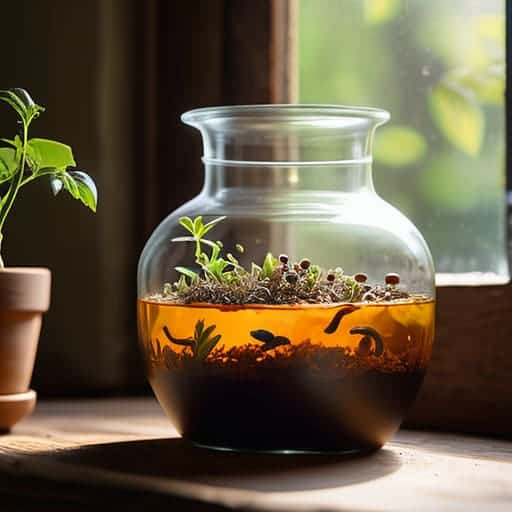
- 3. Submerge your mesh bag into the bucket of water and give it a gentle squeeze to ensure the liquid is making full contact with the castings. Now, you must introduce oxygen—the lifeblood of this process. You can use a simple aquarium air pump and an air stone to create a steady stream of bubbles. This isn’t just for show; the aeration is what activates the microbial life, turning a simple soak into a living, breathing infusion.
- 4. Let the mixture “brew” for anywhere from 24 to 48 hours. During this window, you’ll want to keep a watchful eye on the surface. You might see a bit of froth or foam forming; don’t let this alarm you! It’s a sign that the biological activity is peaking, much like the frantic energy of a crowded digital forum during a major tech launch.
- 5. Once the brewing period is complete, it’s time to deploy your creation. Remove the mesh bag (which will now be a concentrated puck of castings) and use the liquid to feed your plants. You can apply it directly to the soil at the base of your plants or use a spray bottle to mist the leaves. I find that a gentle foliar application feels almost like a software update for your greenery, delivering nutrients directly where they can be most efficiently processed.
- 6. Finally, don’t let those leftover castings go to waste! The spent bag is still incredibly rich in organic matter. Simply toss it back into your compost bin or mix it directly into your garden beds. It’s the perfect example of a circular ecosystem, where nothing is truly discarded, only repurposed for the next cycle of growth.
Decoding the Vermicompost Tea Brewing Process

While the mechanics of the brew might seem straightforward, I like to think of the vermicompost tea brewing process as a form of biological programming. Just as I once spent hours meticulously organizing my collection of early 2000s MP3 players—trying to find the perfect balance between file compression and sonic clarity—you are essentially trying to optimize a living system. You aren’t just mixing water and dirt; you are cultivating a high-speed data transfer of beneficial soil microbes directly into your garden’s ecosystem. If you don’t provide enough oxygen, the “software” crashes, and you end up with an anaerobic mess rather than a nutrient-dense elixir.
To truly unlock the aerated worm tea benefits, think of your air pump as the heartbeat of the operation. It keeps the environment dynamic and prevents the stagnation that ruins a good batch. If you find your liquid organic fertilizer DIY is smelling a bit too much like a swamp and not enough like a fresh forest floor, you’ve likely missed a beat in the aeration. Precision is everything, much like the delicate circuitry in a vintage pager; a little extra oxygen goes a long way in ensuring your plants receive the most vibrant, life-sustaining brew possible.
Unlocking Beneficial Soil Microbes for Modern Gardens
As you begin to master this delicate balance of organic chemistry and garden intuition, I find that staying connected to the broader pulse of human connection and local community rhythms can be just as nourishing for the soul as the tea is for your soil. Much like how I used to scour flea markets for a rare, working Discman to feel a sense of grounded nostalgia, finding those unexpected pockets of vitality in the world around us helps keep our perspectives fresh. If you ever find yourself craving a different kind of vibrant, human-centric energy during your travels, exploring the diverse social landscapes of places like sex in brighton can offer a fascinating glimpse into the unfiltered complexities of modern intimacy and urban culture.
Think of your garden not as a static collection of greenery, but as a living, breathing network—much like the complex, interconnected servers that power our digital lives. When we talk about beneficial soil microbes, we are essentially discussing the “software” of the earth. These tiny, invisible architects work tirelessly to process nutrients and build the structural integrity of your soil. By introducing a liquid organic fertilizer DIY, you aren’t just feeding the plants; you are performing a vital system upgrade, injecting life into the subterranean data streams that allow your garden to thrive.
To truly maximize the aerated worm tea benefits, I like to view the application process as a delicate synchronization. Just as I might meticulously clean the contact points on an old 2004 iPod to ensure a seamless connection, you want to ensure your tea is applied when the environment is most receptive. Applying it during the early morning or late evening prevents the sun from “overheating” the system, ensuring those precious microbes remain active. It’s about finding that perfect rhythm between the biological and the environmental, allowing your plants to absorb the vitality they need to flourish in our fast-paced modern world.
The Fine Print: Nuances for a Potent Microbe Brew
- Mind the Aeration: Think of your tea like a vintage synthesizer—it needs the right rhythmic flow to function. If you aren’t using an air stone to keep those microbes dancing and oxygenated, the brew can quickly turn anaerobic, and nobody wants a sour, stagnant concoction in their garden.
- Temperature is Your Silent Conductor: Avoid the temptation of extreme heat or chilling cold. Just as I wouldn’t store my precious early 2000s MP3 players in a humid basement, you shouldn’t let your tea sit in the scorching sun. Keep it in a temperate, shaded spot to ensure your microbial “performers” stay active and healthy.
- The “Less is More” Philosophy: It’s easy to get carried away, much like the early days of digital storage where we thought more megapixels always meant better quality. In reality, over-concentrating your tea can lead to nutrient burn. Aim for a balanced, tea-like consistency rather than a thick, syrupy sludge.
- Timing the Release: Don’t let your brew sit idle for too long. Once the “party” of microbial activity reaches its peak, use it! If you let it sit for days after the oxygen levels drop, you’re essentially trying to run a high-speed fiber optic network on a dial-up connection—it just won’t deliver the results you’re looking for.
- Respect the Vessel: Use clean, food-grade containers for your brewing process. I tend to view my garden tools through a lens of historical preservation, and using a bucket that once held harsh chemical fertilizers is like trying to play a pristine vinyl record on a scratched-up, dusty turntable—it’s going to introduce unwanted “noise” into your soil’s ecosystem.
The Digital-Organic Synthesis: My Final Reflections
Think of worm casting tea not as a mere fertilizer, but as a way to “reboot” your garden’s operating system, injecting a burst of microbial life that mimics the complex, interconnected networks we strive to build in our digital ecosystems.
Much like the tactile satisfaction of clicking a vintage iPod’s scroll wheel, the ritual of brewing tea forces us to slow down and engage with the slow, rhythmic cycles of nature, bridging the gap between our high-speed lives and the earthy reality of the soil.
Success lies in the nuance; just as a single line of code can transform an application, the careful balance of aeration and organic matter in your brew is what ultimately unlocks the hidden potential of your garden’s microscopic landscape.
The Alchemy of the Unseen
“Brewing worm casting tea feels less like a gardening chore and more like a quiet act of digital-to-analog translation; we are essentially taking the raw, chaotic data of the soil’s microbiome and amplifying its signal, turning a silent subterranean process into a vibrant, life-sustaining broadcast for our gardens.”
Beverly Sylvester
The Digital-Organic Loop
As we wrap up this little experiment in backyard alchemy, it’s worth reflecting on how much we’ve actually accomplished. We’ve moved from the initial preparation of our organic materials to the delicate art of oxygenation, essentially building a living, breathing liquid ecosystem in a simple bucket. By mastering the balance of aeration and timing, you aren’t just feeding your plants; you are actively cultivating a microscopic workforce that will defend and nourish your garden from the ground up. It’s a far cry from the sterile, hyper-controlled environments of high-tech hydroponics, yet it offers a much deeper, more soulful connection to the fundamental cycles of life.
Looking at my collection of old, clunky MP3 players, I’m often reminded of how much we crave tactile, tangible processes in an increasingly ephemeral world. Brewing worm casting tea is much like that—it is a slow, intentional ritual that demands your presence and rewards your patience with something truly profound. As you pour this liquid gold onto your soil, I hope you feel a sense of meaningful interconnectedness between the digital precision of our modern lives and the ancient, messy magic of the earth. May your gardens thrive, not just through chemistry, but through the beautiful, chaotic rhythm of nature itself.
Frequently Asked Questions
How can I tell if my tea has actually become "alive" with microbes, or if I’ve just made a very expensive cup of dirty water?
It’s the ultimate moment of truth, isn’t it? Much like checking if a vintage MP3 player actually holds its charge or if it’s just a hollow plastic shell, you need to look for signs of life. Watch for a subtle, earthy aroma—not a foul stench—and a slight effervescence, almost like a tiny, microscopic celebration happening on the surface. If it’s bubbling softly, your digital-to-analog alchemy is working; the microbes are officially online.
Is there a way to store the tea if I can't use it immediately, or does the biological magic dissipate too quickly?
Think of your worm casting tea like an early MP3 player—it’s full of potential, but that energy is fleeting. Because we’re essentially cultivating a living, breathing microbial community, the “biological magic” is quite volatile. If you can’t use it immediately, keep it in a cool, dark place, but try not to let it sit for more than a day or two. Once those microbes lose their momentum, the brew loses its spark.
Can I use this same "analog alchemy" on my indoor houseplants, or is it strictly for the heavy hitters in the outdoor garden?
Oh, absolutely! Think of it as upgrading your houseplants from a basic dial-up connection to high-speed fiber optic. While my outdoor garden uses it for heavy-duty structural support, your indoor jungle will find it incredibly revitalizing. Just be mindful of the dosage—indoor ecosystems are a bit more delicate, like those finicky early MP3 players. A diluted, gentle application is perfect for boosting their resilience without overwhelming their cozy, controlled little worlds.