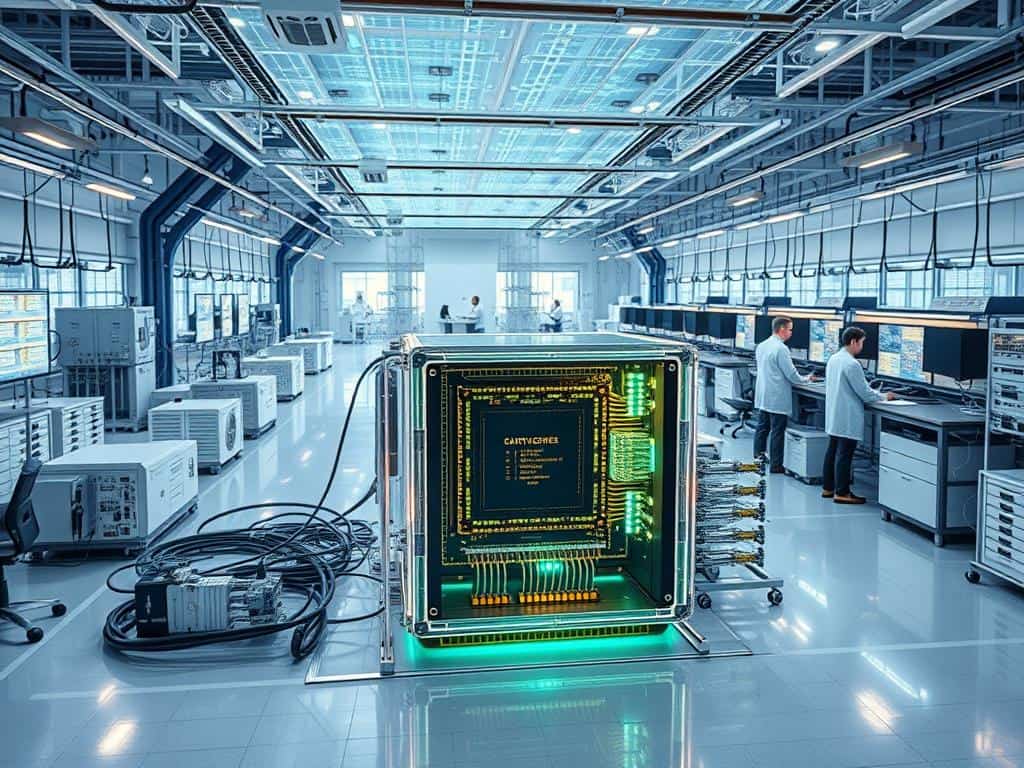
Imagine a computer that can process complex problems at speeds that are orders of magnitude faster than today’s machines. This isn’t science fiction; it’s the promise of quantum computing, a revolutionary technology that harnesses quantum physics to tackle challenges that are currently unsolvable.
By leveraging the power of quantum mechanics, fully realized quantum computers could significantly accelerate the processing of complex information, enabling breakthroughs in various fields, from cybersecurity to pharmaceutical research.
As major tech companies and research institutions race to develop practical quantum computing systems, understanding this emerging field is becoming increasingly important for professionals across industries.
Key Takeaways
- Understanding the fundamental differences between quantum and classical computers.
- The potential applications of quantum computing in various industries.
- The current state of quantum computing technology and its future prospects.
- The importance of quantum computing for professionals in different fields.
- The potential impact of quantum computing on complex problem-solving.
The Fundamentals of Quantum Computing
At its core, quantum computing is about harnessing the strange and fascinating world of quantum mechanics for computational purposes. This emerging field has the potential to revolutionize the way we approach complex problems by leveraging quantum phenomena that classical computers can’t replicate.
What Is Quantum Computing?
Quantum computing is a field that leverages quantum mechanical phenomena to perform computations that would be practically impossible for classical computers. Unlike classical computers, which rely on binary bits (zeros and ones) to store and process data, quantum computers use qubits that can exist in multiple states simultaneously due to superposition. This property allows quantum computers to process a vast amount of data in parallel, making them potentially much faster than classical computers for certain types of calculations.
A Brief History of Quantum Computing
The concept of quantum computing was first theorized in the early 1980s. Physicist Richard Feynman is often credited with launching the field during a 1981 talk about “simulating physics with computers.” A significant milestone came in 1994 when mathematician Peter Shor published a paper describing a quantum algorithm that could quickly factor large numbers, potentially putting much of the world’s encrypted information at risk. Since then, quantum computing has evolved from a theoretical curiosity to a major focus of research and investment by governments and technology companies worldwide.
The development of quantum computing represents not just an incremental improvement in computing power but a fundamentally different approach to solving complex problems. As research continues to advance, we can expect quantum computers to tackle challenges that are currently unsolvable with today’s technology.
Understanding Quantum Mechanics Basics
To grasp the concept of quantum computing, it’s essential to understand the fundamental principles of quantum mechanics that govern its operation. Quantum mechanics is a branch of physics that deals with the behavior of matter and energy at an atomic and subatomic level.
Superposition Explained
Superposition is a fundamental principle of quantum mechanics where a quantum particle or system can exist in multiple states simultaneously. This means that a quantum particle can represent not just one possibility, but a combination of multiple possibilities. To illustrate this concept, consider Schrödinger’s cat, which can be both alive and dead at the same time.
Entanglement: The Quantum Connection
Entanglement is another key principle where multiple quantum particles become correlated in a way that cannot be explained by classical physics, even when separated by vast distances. This phenomenon allows for the creation of a shared state between particles, enabling quantum computing to perform certain calculations more efficiently.
Decoherence and Interference
Decoherence occurs when quantum systems interact with their environment, causing quantum states to collapse into classical states. On the other hand, interference allows probability waves to amplify or cancel each other out, which is crucial for quantum algorithms to work effectively. Understanding these principles is vital for harnessing the power of quantum computing and processing information efficiently.
Quantum Bits: The Building Blocks
The foundation of quantum computing lies in its fundamental building blocks, known as qubits. Unlike classical bits that are either 0 or 1, qubits can exist in multiple states simultaneously, thanks to the principle of superposition.
What Are Qubits?
Qubits are the basic units of quantum information. They are unique because they can represent not just 0 or 1, but a weighted combination of both states at the same time. This property allows quantum computers to process a vast number of possibilities simultaneously.
The ability of qubits to be in a superposition means that two qubits can represent four states, three qubits can represent eight states, and so on, leading to an exponential scaling of quantum information.
How Qubits Store and Process Information
Qubits store information in their quantum states. When qubits are combined, they can perform complex computations by manipulating the information stored in their states. However, upon measurement, a qubit collapses to a single state, outputting a classical bit (0 or 1).
Quantum algorithms leverage the unique properties of qubits to perform certain computations more efficiently than classical computers. By storing and manipulating data in a way that’s inaccessible to classical systems, quantum computers can provide significant speedups for specific problems.
Classical vs. Quantum Computing
Classical and quantum computing represent two fundamentally different approaches to processing information. While classical computers have been the backbone of our digital world, quantum computers are poised to revolutionize the way we tackle complex problems.
How Traditional Computers Work
Traditional computers, also known as classical computers, process information using binary bits. Each bit represents either a 0 or 1, and calculations are performed sequentially. This architecture has been the foundation of computing for decades, enabling us to perform a wide range of tasks, from simple calculations to complex simulations.
The Quantum Advantage
Quantum computers, on the other hand, leverage quantum phenomena like superposition and entanglement to perform calculations in parallel. This enables them to solve certain problems much faster than classical computers. The quantum advantage refers to the point at which quantum computers can solve problems that are practically impossible for classical computers.
When to Use Classical vs. Quantum Approaches
While quantum computers hold great promise, they are not meant to replace classical computers. Instead, they will complement classical systems for specific applications. For most tasks, classical computers will remain the best solution. However, when faced with complex problems like factoring large numbers or simulating quantum systems, quantum computers will be invaluable.
Types of Quantum Processors
The development of quantum computing is witnessing a surge in various types of quantum processors, each with its unique strengths and challenges. As researchers and companies explore different architectures, several promising approaches have emerged.
Superconducting Qubits
Superconducting quantum computing is an implementation of a quantum computer in superconducting electronic circuits. These qubits operate at cryogenic temperatures and are fabricated using modified semiconductor manufacturing techniques. Currently, they are the most widely used in commercial quantum computers.
Trapped Ion Systems
Trapped ion quantum computers use electronic states of charged atoms (ions) as qubits. The ions are confined and suspended above a microfabricated trap using electromagnetic fields. This approach is known for its exceptional coherence times and high-fidelity operations.
Photonic Quantum Computers
Photonic quantum computers encode and process quantum information using particles of light. This approach has the potential for room-temperature operation and natural resistance to certain types of errors, making it an attractive option.
Neutral Atom Processors
Neutral atom qubit technology uses light instead of electromagnetic forces to trap and hold qubits in position. This method offers scalability advantages, as it allows for the manipulation of a large number of atoms.
Topological Qubits
Topological qubits, though still theoretical, promise inherent error protection through their unique physical properties. They represent a promising avenue for achieving fault-tolerant quantum computing.
As stated by a leading researcher,
“The development of fault-tolerant quantum computers will require significant advancements in qubit technology and quantum error correction.”
The diversity in quantum processor designs reflects the ongoing quest for a practical and scalable quantum computer.
Quantum Algorithms and Operations
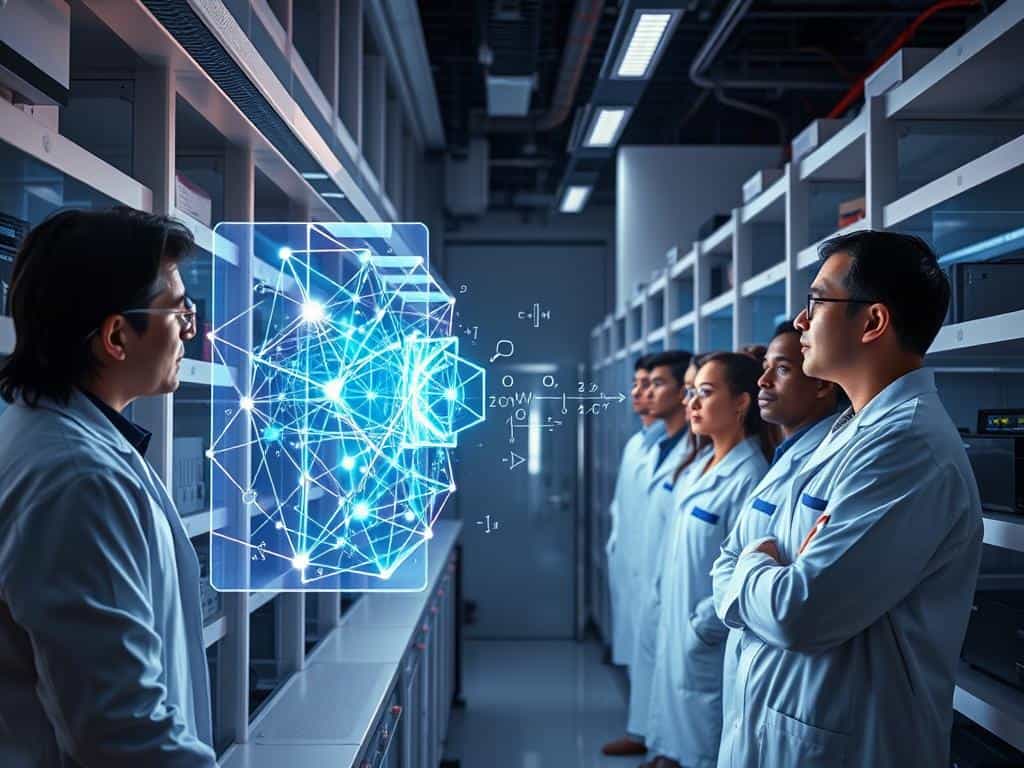
Quantum algorithms are specialized procedures that leverage quantum phenomena to solve specific problems more efficiently than classical algorithms. These algorithms are designed to exploit the unique properties of quantum mechanics, such as superposition, entanglement, and interference, to perform complex computations.
Shor’s Algorithm
Shor’s algorithm, published by MIT mathematician Peter Shor in 1994, is a groundbreaking quantum algorithm that can efficiently factor large numbers. This has significant implications for cryptography, as many encryption systems rely on the difficulty of factoring large numbers. Shor’s algorithm works by preparing a superposition of computational states and using a quantum circuit to generate entanglement, leading to interference between these states.
Grover’s Search Algorithm
Grover’s search algorithm provides a quadratic speedup for searching unsorted databases. This algorithm has potential applications in optimization problems, where the goal is to find the optimal solution among a large number of possibilities. Grover’s algorithm achieves this speedup by using a quantum circuit to amplify the amplitude of the desired state, making it more likely to be measured.
Quantum Fourier Transform
The Quantum Fourier Transform (QFT) is a fundamental building block for many quantum algorithms. It transforms quantum states in ways analogous to the classical Fourier transform, but with the added power of quantum parallelism. The QFT is used in many quantum algorithms, including Shor’s algorithm, to perform complex calculations efficiently.
Quantum algorithms achieve their speedups through clever manipulation of superposition, entanglement, and interference. By harnessing these quantum phenomena, algorithms like Shor’s and Grover’s can solve specific problems much faster than their classical counterparts. Other promising quantum algorithms are being developed for applications in machine learning, chemistry simulation, and optimization problems.
Current State of Quantum Computing
As we stand at the forefront of quantum computing, it’s clear that the field is poised for significant growth. With leading institutions such as IBM, Microsoft, Google, and Amazon joining eager startups like Rigetti and IonQ in investing heavily in this exciting new technology, quantum computing is estimated to become a USD 1.3 trillion industry by 2035.
Quantum Volume and Performance Metrics
In 2019, leading researchers on the IBM Quantum team invented a metric known as quantum volume to assign a singular, calculable measurement of a quantum computer’s ability. Quantum volume measures the largest quantum circuit that can pass a quantum volume test, providing a comprehensive assessment of a quantum computer’s performance.
Leading Companies in Quantum Computing
The quantum computing landscape is dominated by tech giants and innovative startups. Companies like IBM, Google, Microsoft, and Amazon are at the forefront, driving advancements in quantum technology. Specialized startups such as Rigetti and IonQ are also making significant contributions, pushing the boundaries of what’s possible with quantum computers.
“Quantum computing is not just a new type of computing; it’s a new way of processing information that can solve problems that are currently unsolvable with traditional computers.”
Recent Breakthroughs
Recent years have seen significant breakthroughs in quantum computing, including demonstrations of quantum advantage and improvements in error correction techniques. These advancements are crucial for the development of practical quantum computers that can be used in real-world applications.
As research continues to advance, we can expect to see further improvements in the capabilities and limitations of today’s quantum computers, bringing us closer to harnessing the full potential of quantum computing.
Challenges in Quantum Computing Development
One of the significant challenges in quantum computing development is ensuring the stability and coherence of qubits. Qubits are exquisite but fragile; a stray electric or magnetic field, temperature fluctuations, or even a cosmic ray can ruin a superposition or entanglement, forcing qubits into a 0 or 1 state where they act like ordinary bits.
Error Correction and Quantum Decoherence
Quantum decoherence is a major issue, as quantum states are extremely fragile and easily disrupted by interaction with their environment, leading to errors. Quantum error correction is much more complex than classical error correction, requiring multiple physical qubits to create a single logical qubit. The best quantum computers today contain hundreds of interconnected qubits and make an error roughly once in every thousand operations.
An error changes the state of a qubit, destroying or corrupting the information it carries. To mitigate this, researchers are exploring various quantum error correction techniques that can detect and correct errors without directly measuring the qubits.
Scalability Issues
As quantum computing systems grow larger, maintaining coherence becomes increasingly difficult. Scalability is a significant challenge because the more qubits a system has, the more prone it is to errors due to decoherence. Moreover, as the number of qubits increases, so does the complexity of controlling and calibrating them.
To overcome these challenges, advancements in materials science, cryogenics, and control electronics are necessary. The development of more robust qubits and improved quantum computing architectures is crucial for achieving fault-tolerant quantum computation.
Practical Applications of Quantum Computing
The practical applications of quantum computing are vast and varied, promising breakthroughs in multiple fields. Quantum computers excel at solving certain complex problems, potentially speeding up the processing of large-scale data sets. This capability could lead to significant advancements in various industries, from the development of new drugs to supply-chain optimization and climate change mitigation.
Cryptography and Security Implications
Quantum computers could revolutionize cryptography by breaking current encryption methods and enabling new, quantum-resistant security protocols. This dual capability has profound implications for data security, potentially rendering current cryptographic systems obsolete while offering more secure alternatives.
Drug Discovery and Materials Science
Quantum simulation could transform drug discovery and materials science by accurately modeling molecular interactions that are impossible to simulate with classical computers. For instance, quantum computers could simulate molecular behavior and biochemical reactions, massively speeding up the research and development of life-saving new drugs and medical treatments.
Optimization Problems
Quantum computing could solve complex optimization problems in logistics, finance, and energy distribution, potentially saving billions of dollars and reducing environmental impact. By efficiently solving these problems, quantum computers could lead to more streamlined and cost-effective operations across various industries.
Machine Learning and AI
The intersection of quantum computing and artificial intelligence is another promising area, with quantum machine learning algorithms potentially processing data in fundamentally new ways. This could lead to breakthroughs in AI capabilities, enabling more sophisticated and efficient data analysis.
In conclusion, the practical applications of quantum computing are diverse and hold significant potential for transforming various industries. As research and development continue, we can expect to see quantum computing’s impact in areas ranging from more effective medications to more efficient transportation networks.
Quantum Computing and Cybersecurity
With the development of quantum computing, cybersecurity is facing a potentially catastrophic threat. The algorithms that encrypt much of our data work by multiplying very large prime numbers together to create a secret key — something that’s very hard for classical computers to undo.
The emergence of quantum computers poses a significant risk to these encryption methods. Shor’s algorithm, a quantum computing algorithm, can quickly factor the immense numbers that are products of huge prime numbers, potentially putting much of the world’s encrypted information at risk.
Threats to Current Encryption
Shor’s algorithm threatens RSA and other public-key cryptography systems that secure much of our digital infrastructure, from online banking to secure communications. The timeline for this threat is critical; as quantum computers become more powerful, the risk to current encryption methods increases. It’s essential to understand that the development of quantum computing is not just about processing power; it’s about the potential to break the encryption that protects our data.
Post-Quantum Cryptography
In response to this threat, post-quantum cryptography, also known as quantum-resistant cryptography, is being developed. NIST has initiated a Post-Quantum Cryptography Standardization process to develop new algorithms that are thought to be quantum computer-proof. These new encryption methods are designed to withstand attacks from quantum computers, ensuring continued security in a post-quantum computing world.
Organizations and individuals must prepare for the time when quantum computers will be capable of breaking current encryption, including being aware of “harvest now, decrypt later” attacks. By understanding the implications of quantum computing on cybersecurity and adopting post-quantum cryptography solutions, we can mitigate the risks associated with the advent of quantum computers.
The Future of Quantum Computing
With advancements in quantum technology, we are on the cusp of a new era in computing. The concept of quantum advantage refers to the hypothetical ability of a quantum computer to outperform all classical supercomputer methods for certain problems.
Quantum Advantage and Utility
Quantum utility is about providing reliable, accurate solutions to problems beyond the reach of classical computing. A quantum computer capable of achieving quantum advantage should deliver significant, practical benefits beyond classical computing methods. This includes calculating solutions that are cheaper, faster, or more accurate than any available classical alternatives.
Timeline for Practical Quantum Computers
Expert predictions vary on when we might achieve fault-tolerant quantum computers capable of solving commercially relevant problems. The development of quantum computing is expected to have a significant economic impact, with estimates suggesting a growing market size and industry transformation. As quantum computing evolves alongside other emerging technologies like artificial intelligence, it is likely to create new synergies and capabilities.
The future development of quantum computers will likely distinguish between near-term, mid-term, and long-term prospects. While there are optimistic scenarios for quantum computing development, there are also technical uncertainties that remain.
Conclusion
As quantum computing continues to evolve, its potential to transform industries and reshape our technological landscape is becoming more apparent. Throughout this guide, we’ve explored the fundamentals of quantum computing, from the basics of quantum mechanics to the current state of quantum computers.
The transformative power of quantum computing lies in its ability to process information in a fundamentally different way, enabling it to tackle complex tasks that are currently unsolvable by classical computers. While significant challenges remain, the rapid progress in technology and research is promising.
As we move forward, understanding quantum computing, even at a high level, is becoming increasingly important for professionals across many fields as we enter the quantum era. Staying informed about developments in this technology will be crucial.